What is a flat white?
Last updated 17 Oct 2026
You’ve seen it on the board at every Aussie café and wondered if it’s just a latte with an accent. Fair question.
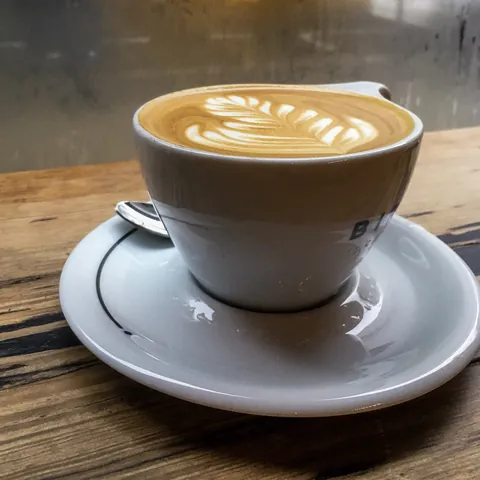
Short answer: a flat white is espresso with silky, finely textured milk and a thin layer of microfoam, in a small cup. Usually a double shot these days, sometimes a single. That’s it.

It’s a small drink, about 160 ml, or 5.5 fl oz. That’s a lot smaller than a typical American latte. Same espresso, less milk, so the coffee actually comes through.
Who invented it? Australia and New Zealand both claim it, and neither side is backing down.
Here’s what you’ll usually get if you order the other two at a US café:

Why it’s our test
This is our view, not science: if a café nails a flat white, the rest of its coffee is usually good too. It’s a bit like an Aussie pub. If it can’t do a decent parmy, you wouldn’t trust it with the steak.
What makes a good flat white
- Small cup. Around 160 ml (5–6 oz). If it shows up in a 12 oz paper cup, it’s a latte in disguise. Nice try, though.
- Proper espresso. Usually a double. Heaps of Aussie cafés pull it as a double ristretto, a shorter, more concentrated shot.
- Thin, glossy microfoam. The milk should look like wet paint, with a thin layer that sits flat at the rim. No stiff foam cap, no big bubbles. That’s the “flat” bit.
- Milk that isn’t scalding. The sweet spot is 55–65°C (about 130–150°F), and never past 70°C (158°F). Any hotter and it starts to taste scorched.
Do you need sugar?
Probably not, if the milk’s done right. Warm, well-steamed milk really does taste sweeter than cold milk.
Here’s the fun bit: steaming doesn’t actually add sugar. If it did, the milk would stay sweet when it cooled down, and it doesn’t. It’s your tongue. Sweet taste gets stronger as things warm up, and scientists have even found the taste-cell channel that’s switched on by heat.
So we reckon you try a good flat white without sugar first. Still want some? No worries. Plain sugar is the simple choice. It adds sweetness without the extra flavour a syrup brings. That part’s taste, not science.
Ordering one in the US
- Just ask for a “flat white”. Aussie-run cafés will know exactly what you mean. Elsewhere, it might come bigger and milkier.
- Go the smallest size if there’s a choice.
- Say “not too hot” if the milk keeps coming out scalding. “Around 140°F” is a handy number if the barista asks, even if they’re flat chat.
- Can’t get one? Ask for a “cortado with a bit more milk” or a “small latte, double shot”. Not identical, but close. Either way, it beats a servo coffee.
Words tripping you up? The Aussie lingo glossary has you covered, flat white vs latte vs long black sorts out the menu, and how to order like an Aussie handles the rest.
Now find an Aussie café near you and order one this arvo. Give it a crack, mate!
Quick answers
What is a flat white?
Espresso, usually a double, with silky, finely textured milk and a thin layer of microfoam, served in a small cup of about 160 ml (5.5 fl oz).
Is a flat white stronger than a latte?
It tastes stronger. It uses the same espresso but less milk than a typical American latte, so the coffee comes through more.
Does a flat white need sugar?
Not if the milk is steamed well. Warm, properly steamed milk tastes noticeably sweeter than cold milk. If you still want sugar, that's your call.
What is a long black?
A double shot of espresso poured over hot water, similar to an Americano.
Sources (8)
- Tourism Australia, Australian coffee cheat sheet (single or double shot)
- Bluestone Lane menu
- City Cast Salt Lake, Australian coffee explainer
- Nescafé Australia, What is a flat white? (cup size, ratio)
- Coffee Hero, What is a flat white? (double ristretto, flat microfoam surface)
- Perfect Daily Grind, citing the SCA's milk temperature guidance (55–65°C, max 70°C)
- Barista Hustle, Lactose and lactase, quoting Prof Steven Abbott (why steamed milk tastes sweeter)
- Talavera et al. (2005), Heat activation of TRPM5 underlies thermal sensitivity of sweet taste, Nature 438